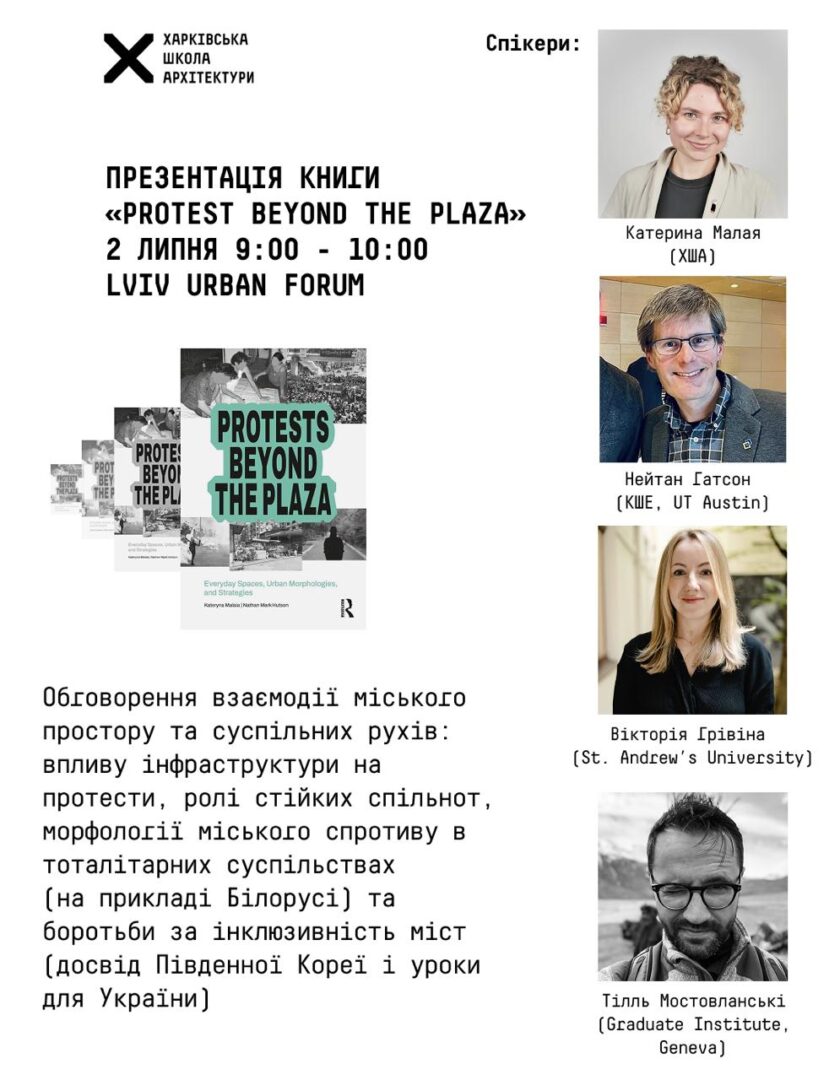
Book presentation of Protests Beyond the Plaza as part of the Lviv Urban Forum programme
Public program
02.
07
2026
As democratic governance systems deteriorate worldwide and dictatorships strengthen, protests become central mechanisms for expressing public will and pursuing justice. Although abstract at the national and even global levels of governance, protests are deeply rooted in concrete places where people gather to express their dissent. Through the physical presence of people in space, a protest returns politics to reality, makes it palpable, and hence enables change. Protests Beyond the Plaza argued that the political and spatial dimension of protests extends past the signature space where they culminate–often an urban plaza–and into the rest of the city where they are born, build momentum, sustain, regroup, and eventually mellow out into peace-time civic cooperation if the goals of the protest have been achieved.
At Urban Forum, we will discuss how this Ukraine-inspired book looking at cases around the world, came to be. We will look into the meaning assigned to urban spaces during protests. We will discuss the legacy of Maidan and the most recent round of Cardboard Protests in 2025, and the protests around the world that Ukrainians can learn from. We will also discuss different urban contexts and forms, and how they may halt or help protests through the example of Belarus, which cannot be more different from Ukraine at the moment, but shares a lot of urban features because of the common Soviet planning past.
Kateryna Malaia, architectural historian and lecturer at the Kharkiv School of Architecture.
Nathan Hutson, urban planner and researcher, Kyiv School of Economics and University of Texas at Austin.
Till Mostowlansky, anthropologist, Graduate Institute for International Development Studies, Geneva.
Victoriia Hrivina, anthropologist, St. Andrew’s University.