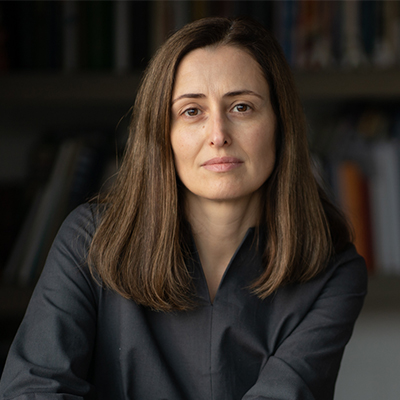
Dr Iryna Matsevko is a historian and the Vice-Chancellor of the Kharkiv School of Architecture (since 2024). She earned her PhD in 2000 with a dissertation on Neo-Slavism as an ideological project and its reception within the political and intellectual milieus of Galicia. Her academic background is rooted in the social history of modern Central and Eastern Europe, the history of ideas, and heritage studies.
Between 2000 and 2007, she taught at the Faculty of History of the University of Lviv. Her teaching covered the history of Central and Eastern Europe, the social history of the Soviet Union, and intellectual history. From 2008 to 2019, she worked at the Center for Urban History in Lviv, where she first served as Academic Coordinator and later as Deputy Director and Head of Public History. During this period, her work focused on former multi-ethnic urban contexts, exploring how different memories can be engaged, mediated, and reinterpreted to foster inclusive historical understanding and public dialogue in Central and Eastern Europe’s cities.
She has been involved in several long-term heritage initiatives, including the Space of Synagogue Commemorative Project in Lviv and ReHERIT: Common Responsibility for Shared Heritage. Within ReHERIT, she developed and coordinated projects in Uman and Lviv that addressed cobtested narratives of urban heritage. She was also editor and co-author of the publication Uman. (Un)known Stories of the City.
In 2021, Iryna Matsevko joined the Kharkiv School of Architecture as Deputy Vice-Chancellor and lecturer in the humanities. Since 2022, she has led the School’s heritage profile, particularly in relation to post-war reconstruction, adaptive reuse, and heritage as a social and cultural resource. She teaches courses in heritage studies, critical reconstruction, and the cultural and social contexts of architecture. Through her involvement in international projects, she explores heritage as a field that brings together difficult pasts, present community needs, and shared visions of the future.
Her research interests include the development of teaching methodologies for heritage across different levels of architectural education, from undergraduate programmes to professional training for practicing architects. Her work addresses dissonant heritage and identity, the social dimensions of built heritage, and the role of heritage in fostering community resilience, reconstruction, and long-term urban development.
She has also participated in international fellowships and professional development programs, including the German Institute of History in Warszaw (2007), the Young Scientist Program of the Polish Government (2007–2008), the Urban Heritage Strategies course at the Institute of Housing and Urban Development Studies, Erasmus University, Rotterdam (2023), the Open World professional exchange programme in the United States (2025), and internship at the Cité de l’Architecture et du Patrimoine in Paris (2025).
e-mail: [email protected]