International Workshop Building Back Better: Kharkiv (2026)
01.
02
2026
Kharkiv is the home city of the Kharkiv School of Architecture and the place where its educational philosophy and academic community were formed. As one of Ukraine’s largest frontline cities, Kharkiv continues to experience the realities of war while simultaneously becoming a laboratory for rethinking architecture, urban resilience, and the future of post-war recovery. For KhSA, researching Kharkiv is both an academic responsibility and a way of maintaining a living connection with the city despite the School’s temporary relocation to Lviv.
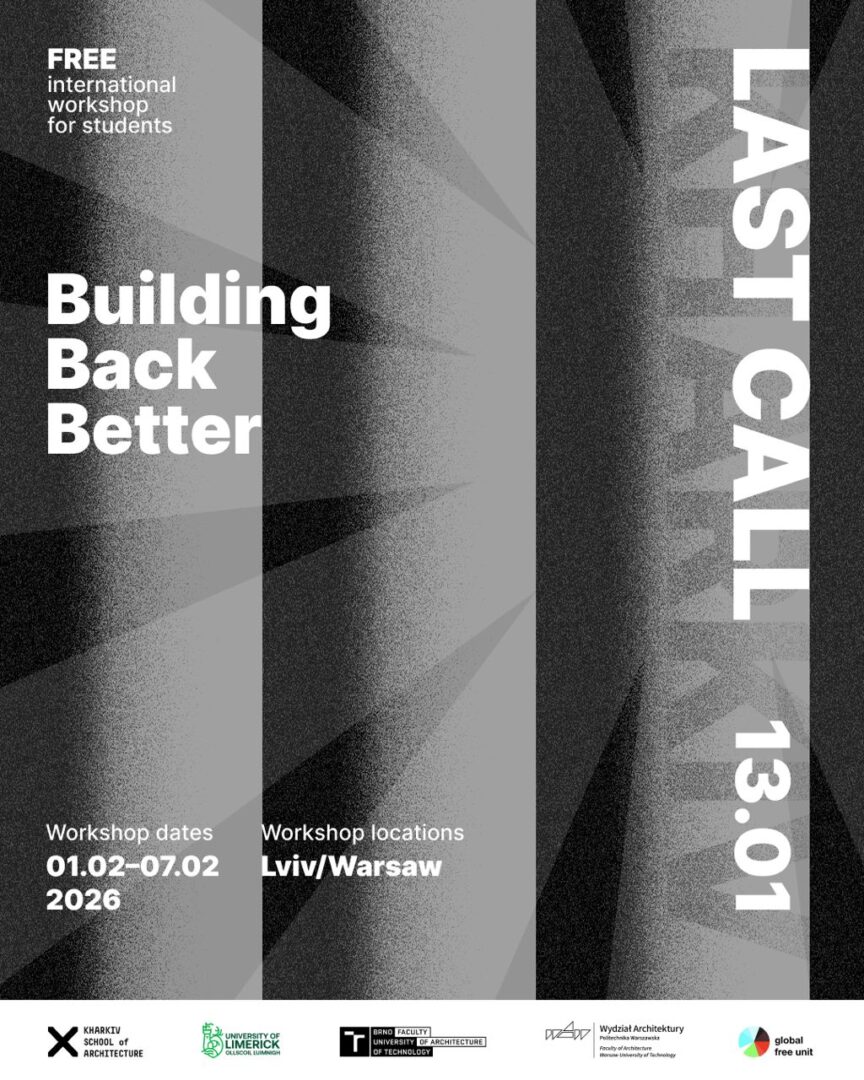
Held in Lviv from 1–7 February 2026, Building Back Better: Kharkiv brought together students and faculty from the Kharkiv School of Architecture and partner universities across Europe to explore the challenges of architectural thinking in a city shaped by war. Focusing on Kharkiv, the workshop investigated how architecture and urban design can respond to destruction, uncertainty, and long-term transformation through collaborative, research-based design.
Working in four interdisciplinary studios, participants examined the city from complementary perspectives: the relationship between physical and social space; the role of protection and care through the lens of Kharkiv’s markets; the future of Saltivka’s modernist housing estates; and the myths, narratives, and imaginaries that shape the city’s identity. The workshop concluded with a public exhibition presenting research findings and design proposals through maps, spatial scenarios, installations, models, films, and visual narratives.
Studio 1 | Building? Back? Better?
This studio explored the relationship between the physical and social dimensions of urban space in times of war. Through personal narratives, comparative analysis of different cities, and critical reflection, participants examined how conflict reshapes perceptions of place, community, and belonging, questioning what it means to rebuild beyond physical reconstruction.
Studio 2 | 110 Hectares to Care For: Exploring the Meaning of Protection in the Context of Kharkiv’s Markets
Focusing on Kharkiv’s markets, the studio investigated protection as an architectural, social, and political practice. Through field research, interviews, and collective analysis, participants explored markets as spaces of resilience, exchange, and everyday urban life, asking how care and transformation can become forms of protection in a city affected by war.
Studio 3 | Saltivka Living: II-57
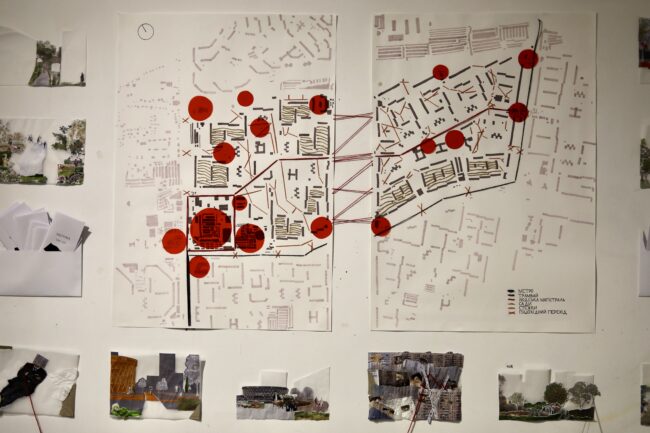
This studio examined Saltivka, Kharkiv’s largest modernist housing district, as a living urban landscape shaped by war, memory, and everyday life. Participants developed research-based proposals that reconsidered housing, public space, green infrastructure, and the future of Soviet-era neighbourhoods in the context of long-term recovery and transformation.
Studio 4 | New-New Kharkiv: Myths and Dreams of a War City
Rather than focusing on physical reconstruction, this studio explored Kharkiv through its stories, myths, and cultural imaginaries. Combining architectural research with anthropological and artistic methods, participants reflected on how narratives shape the city’s identity and influence possible futures for a city living through war.
Teachers:
Oksana Chebina is an architect educated in Ukraine and Germany, with professional experience in both contexts. She has worked with FAKT – Office for Architecture, where she contributed to the publication Berlin Maps. Alongside her architectural practice, she is actively engaged in architectural education as a workshop tutor, lecturer, and guest critic. Her teaching approach emphasizes design as a collaborative process, combining conceptual thinking with hands-on experimentation and an awareness of social and cultural contexts. She is a co-founder of assemble.berlin, an initiative offering architecture workshops for children with migration backgrounds, and since 2023 a member of chora | atelier für architektur, a Berlin-based cooperative and Germany’s first architecture practice with steward ownership.
Viktoriia Grivina is a writer and urban anthropologist. She holds a Master’s degree in linguistics of Kharkiv National University, and MA in Cultural Studies via Erasmus Mundus Master’s Scholarship. In 2020, she joined “(Un) Archiving (Post)Industry” Project, digitizing the photographic legacy of Donbas (received Europa Nostra 2023 award). Her PhD research at the University of St Andrews is dedicated to the transformation of local communities in Kharkiv, Ukraine. In 2025, she was awarded David Riches Medal in Social Anthropology. She is the author of Kharkiv, A War City (Ibidem, 2025), and a co-author of the volume, Kharkiv is a Dream: Public Art and Activism 2013–2023 (Ibidem, 2025).
Kateryna Malaia, PhD is an architectural historian and educator teaching at Kharkiv School of Architecture and the University of Utah. She researches ordinary architectures, particularly housing, under pressure and in times of change. Her first book, Taking the Soviet Union Apart Room by Room (NIUP/Cornell UP) was published in 2023. Her book Mass Housing in Ukraine (with Philipp Meuser, DOM Publishers) was published in September 2024. Her co-edited volume Protests Beyond the Plaza (co-edited with Nathan Mark Hutson) is forthcoming with Routledge (2026). In 2026, Malaia was awarded Kristine Fallon Prize for her article “Missing Women: Ukrainian Architects of the 1930s.”
Vasylysa Shchogoleva is a Berlin-based artist and architect originally from Kharkiv. With a background in architecture and fine arts, she holds a double Master’s degree from Dessau-Roßlau (Germany) and Kharkiv (Ukraine). Her work focuses on participatory and research-based practices that disrupt structures which no longer serve us and build new forms of connection and solidarity. Through visual interventions and installations in public space in Berlin and Kharkiv, Vasylysa explores collective memory, belonging, and healing, creating spaces where diverse voices meet and new futures can be imagined. Her practice spans art, architecture, design, and education. In 2025, she joined the Kharkiv School of Architecture as a co-lecturer of Methods and Tools of Urban Research, Participatory Practices. She is a co-founder of an NGO Critical Thinking (since 2015) with a strong focus on community-based practices in the large housing-estate of Saltivka (Kharkiv, Ukraine). She is a co-author of Kharkiv is a Dream. Public Art and Activism 2013–2023 (ibidem, 2025).
Maria Tselik is an architect with MA in Architecture from the Kharkiv National University of Civil Engineering and Architecture. Since 2011, she is a practising designer of public interiors. Works at the intersection of architectural practice, education, health and well-being issues. Additional professional interest: product design. In 2022 and 2023, in collaboration with lighting manufacturer LOFU, she represented Ukraine at the collective stand of Ukrainian industrial designers at the Maison & Objet international exhibition in Paris. Since 2017, Tselik cooperates with the Kharkiv School of Architecture. In 2017–2018, she was a Foundation Year Tutor in Material Implementation and Ethics; since 2019, she is a BA Studio Tutor. In 2025, she joined the MA program as a co-lecturer for the course Methods and Tools of Urban Research and as a Studio Tutor.